The Biggest Controversy in Cosmology Just Got Bigger: Understanding the Hubble Tension
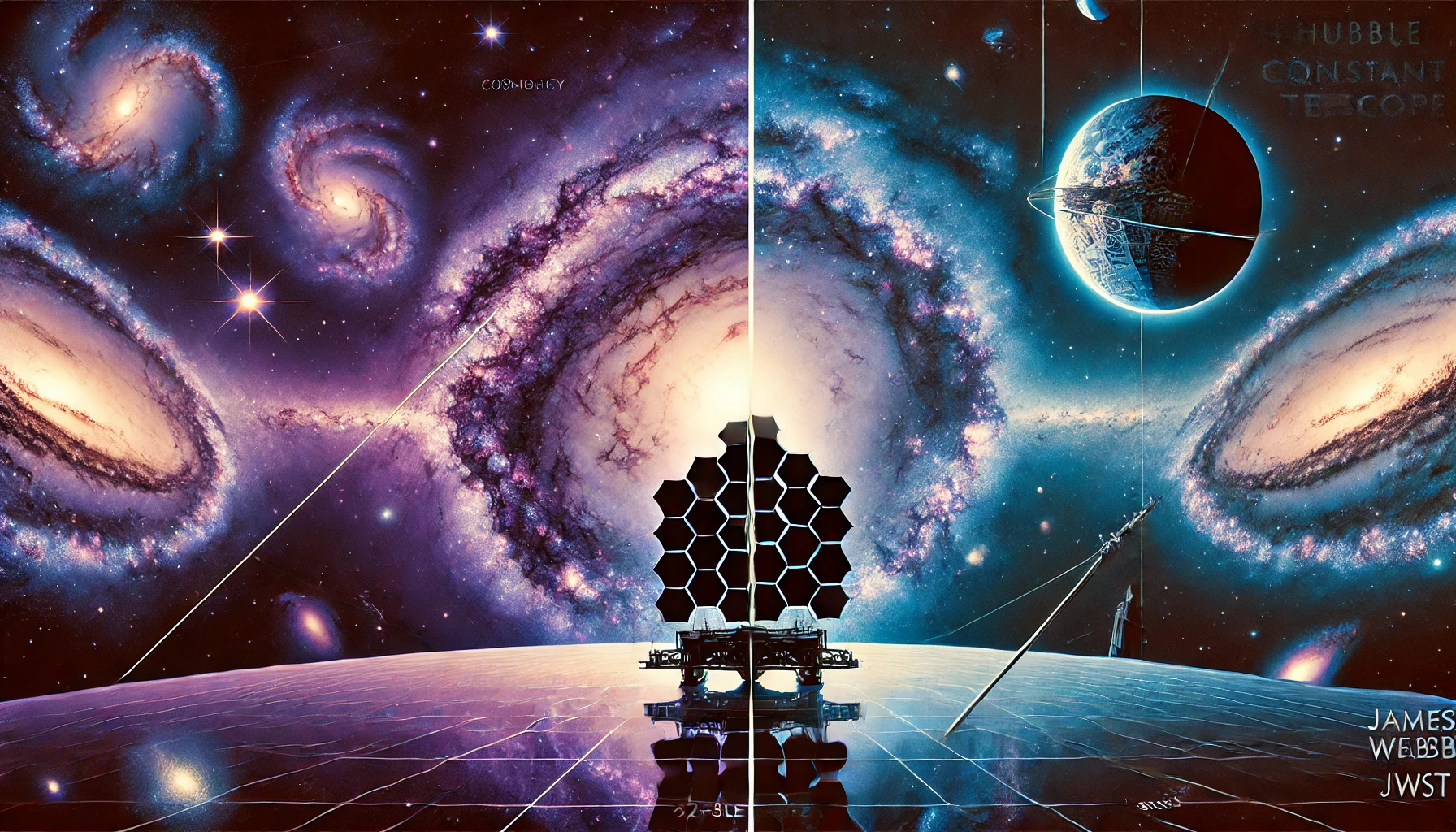
The universe is expanding, but the rate of that expansion is at the heart of what many are calling “The Biggest Controversy in Cosmology.” Known as the Hubble tension, this discrepancy in the rate at which the universe is expanding has sparked debates and raised fundamental questions about our understanding of the cosmos. While scientists have long accepted the existence of dark energy and the cosmological constant, the discovery of conflicting measurements has deepened this cosmology crisis.
In this blog, we will explore the Hubble tension, how measurements of Cepheid stars and red giants are used to estimate cosmic expansion, and how cutting-edge tools like the James Webb Space Telescope (JWST) are helping scientists understand the forces shaping the universe.
What Is the Hubble Tension?
The Hubble tension refers to a significant mismatch between two methods of calculating the cosmic expansion rate, known as the Hubble constant (H₀). One method uses observations of the early universe, while the other measures the expansion rate based on nearby galaxies.
Scientists expected these two values to align, but they don’t. The Planck mission, which studies the early universe, predicts an expansion rate of approximately 67.4 kilometers per second per megaparsec. However, measurements of nearby galaxies, using Cepheid stars and other indicators, suggest a faster rate of around 73 km/s/Mpc.
This discrepancy challenges the current cosmological model and raises profound questions: Are we missing key pieces of the puzzle? Could dark energy be different from what we’ve assumed, or are new forces like primordial magnetic fields at play?
Measuring the Universe: Cepheid Stars, Red Giants, and Supernovae
Understanding the size and age of the universe relies on accurate measurements of cosmic distances. Astronomers use “standard candles” like Cepheid stars, red giant stars, and supernova distance measurements to gauge the distances between celestial objects. Each method plays a vital role in determining the expansion rate of the universe and is crucial to resolving the Hubble tension.
Cepheid Stars: Key to Unlocking Distance
Cepheid stars are pulsating stars whose brightness changes at regular intervals. Because the relationship between a Cepheid star’s pulsation period and its intrinsic brightness is well understood, astronomers can use them to measure distances with remarkable precision. These stars have been instrumental in calculating the universe’s expansion rate, particularly in nearby galaxies.
The problem? Cepheid stars live in crowded, dusty regions of galaxies, making their measurements prone to error. The James Webb Space Telescope (JWST), with its advanced infrared technology, has been able to peer through the dust to refine these measurements, but the conflict with the cosmic expansion rate derived from the early universe remains.
Red Giants: An Alternative Method
Astronomers also use red giant stars to measure cosmic distances. These stars undergo a sudden drop in brightness as they ignite helium in their cores, providing a distinct marker for calculating distances. By comparing red giants in different galaxies, astronomers have another tool to measure the expansion of the universe. Though more challenging to use than Cepheid stars, red giants are located in less crowded parts of galaxies, offering a potentially cleaner measurement method.
Supernova Distance Measurements
Another method involves supernova distance measurements, particularly Type Ia supernovae, which are used as standard candles because they explode with consistent brightness. By comparing the observed brightness with their known intrinsic brightness, astronomers can calculate the distance to their host galaxies, providing yet another data point in determining the cosmic expansion rate.
The Role of Dark Energy and the Cosmological Constant
For decades, the mysterious force known as dark energy has been accepted as the driving force behind the accelerating expansion of the universe. It is often explained through the cosmological constant, a term introduced by Einstein in his theory of general relativity. The cosmological constant suggests that the vacuum of space itself exerts a repulsive force, causing galaxies to drift apart faster over time.
But the discovery of the Hubble tension has led some scientists to question whether dark energy is as straightforward as we once thought. Could there be new, undiscovered forces—like primordial magnetic fields—altering the behavior of the universe?
Some theories propose that dark energy may not be constant over time but could vary in strength, while others suggest that we are simply observing the expansion of the universe differently depending on where and when we measure it. These open questions have left cosmologists puzzled, as new data continues to raise more questions than answers.
The James Webb Space Telescope: Shedding Light on the Cosmology Crisis
Launched in 2021, the James Webb Space Telescope (JWST) has quickly become a game changer in the world of astronomy. With its powerful infrared capabilities, the JWST can observe celestial objects with unprecedented clarity, cutting through dust and gas to capture data that previous telescopes like Hubble could not.
One of JWST’s primary missions is to help resolve the Hubble tension by improving our measurements of Cepheid stars, red giant stars, and supernovae. The telescope’s precision is allowing astronomers to test whether measurement errors, dust, or even unseen cosmic factors are contributing to the discrepancies in the cosmic expansion rate.
What Has JWST Found So Far?
Initial results from JWST show a close agreement with previous Hubble measurements of nearby galaxies. This suggests that the conflict isn’t due to local measurement errors or dust obscuring Cepheid stars. Instead, the discrepancy may be pointing to new physics, such as unknown forms of dark energy or even previously unconsidered forces like primordial magnetic fields.
If JWST continues to confirm these findings, the implications for cosmology will be profound. It may mean that our understanding of the universe is incomplete and that exciting new discoveries are on the horizon.
What’s Next for the Cosmology Crisis?
The discovery of the Hubble tension has left the scientific community divided, and solving this cosmology crisis may take years of further research. The JWST will continue to play a crucial role in this investigation, but other approaches are also being developed. For instance, future missions such as the Nancy Grace Roman Space Telescope and the Euclid Space Telescope will offer complementary data, helping scientists refine their models of the universe.
In the meantime, theorists are working to develop new models of the cosmos that might resolve the Hubble tension. Some of the most intriguing proposals involve modifications to the cosmological constant, new forms of dark energy, or previously undetected interactions between cosmic forces.
A Bigger Controversy in Cosmology
The Hubble tension represents one of the biggest mysteries in modern cosmology, and it’s only growing more complex as new data comes in. Whether through better measurements of Cepheid stars, advanced observations from the James Webb Space Telescope (JWST), or new theoretical breakthroughs, the solution to this cosmology crisis will likely reshape our understanding of the universe.
As scientists continue their search for answers, the controversy over how fast the universe is expanding will remain a central focus in the field. Solving it could lead to the discovery of new cosmic forces, a deeper understanding of dark energy, or even the first revisions to our fundamental laws of physics in decades.
To explore more on this fascinating subject and gain further insights into cosmology and space exploration, visit Regent Studies.