NASA’s Discovery of New Gamma-ray Emissions: Unlocking the Mysteries of Tropical Thunderstorms
NASA researchers have long been exploring the mysteries of our planet’s atmosphere, and their latest findings regarding gamma-ray emissions in tropical thunderstorms have sent waves through the scientific community. These NASA gamma-ray emissions are reshaping how we understand thunderstorms, revealing that these powerful storms can produce incredibly high-energy flashes of light—gamma rays—previously only associated with distant cosmic events. With the help of cutting-edge technology, such as the NASA Fermi Gamma-ray Space Telescope, scientists are unraveling the complexities behind terrestrial gamma-ray flashes, tropical thunderstorms, and high-energy gamma rays.
In this blog post, we’ll explore NASA’s groundbreaking discoveries and their implications for atmospheric science and space weather.
What Are Gamma-ray Emissions and How Do They Occur?
Gamma rays are the most energetic form of electromagnetic radiation, possessing far more energy than visible light or even X-rays. Until recently, gamma rays were primarily associated with extreme cosmic events like supernovas and gamma-ray bursts, where massive explosions send intense radiation across the universe. However, NASA researchers have now discovered that thunderstorms on Earth can produce gamma rays as well.
In tropical thunderstorms, especially those occurring over oceans, these gamma-ray flashes are not only common but can be detected more frequently than originally thought(NASA Science)(NASA Technical Reports Server). NASA gamma-ray emissions occur when high electric fields in storm clouds accelerate electrons to nearly the speed of light. When these electrons collide with air molecules, they emit brief but powerful bursts of gamma rays. These terrestrial gamma-ray flashes (TGFs) are some of the most energetic forms of radiation generated on Earth.
NASA’s Fermi Gamma-ray Space Telescope and Gamma-ray Bursts
NASA’s Fermi Gamma-ray Space Telescope has played a critical role in studying gamma-ray emissions, both from distant cosmic sources and from thunderstorms on Earth. Since its launch in 2008, Fermi has recorded over 4,000 TGFs and gamma-ray bursts, providing unprecedented insights into these phenomena(NASA Scientific Visualization Studio).
The telescope has helped scientists better understand the connection between gamma rays and lightning. Tropical thunderstorms, particularly those with intense lightning activity, can trigger TGFs, creating conditions similar to those found in cosmic gamma-ray bursts. Fermi’s data, combined with other ground-based observations, has helped researchers pinpoint the location and intensity of TGFs, leading to NASA’s latest discoveries.
Terrestrial Gamma-ray Flashes in Tropical Thunderstorms
While thunderstorms have always been associated with lightning, it’s only recently that scientists have uncovered their ability to produce gamma rays. NASA’s latest research shows that TGFs are more common in tropical thunderstorms than in storms at higher latitudes. This is due to the intense convection within tropical systems, which drives clouds higher into the atmosphere and creates stronger electric fields.
How Do Terrestrial Gamma-ray Flashes Work?
In thunderstorms, the electric field builds up between the top of the cloud and the ground. Under the right conditions, the field becomes strong enough to cause a runaway effect, accelerating electrons to nearly the speed of light. As these electrons interact with air molecules, they emit brief pulses of high-energy gamma rays, known as TGFs(NASA)(NASA Science).
These TGFs last only a fraction of a second, but they produce radiation with millions of times the energy of visible light. NASA’s research into gamma-ray emissions has revealed that thunderstorms can produce different types of gamma-ray flashes, some of which last longer than others and are influenced by the storm’s structure and intensity.
Gamma-ray Glows in Thunderstorms: A New Discovery
In addition to terrestrial gamma-ray flashes, NASA researchers have discovered a new type of gamma-ray emission: gamma-ray glows. These emissions are different from the brief flashes seen in TGFs. Instead, gamma-ray glows are more sustained, lasting several seconds to minutes, and are observed as the thunderclouds glow with a steady stream of gamma rays(NASA Science).
Gamma-ray glows occur when thunderstorms contain high electric field regions that cause electrons to emit continuous gamma rays. Unlike TGFs, which are extremely brief, gamma-ray glows can last long enough to be observed by multiple sensors and aircraft. This new discovery fills a gap in scientists’ understanding of how thunderstorms produce radiation and provides valuable data for future atmospheric research.
Tropical Storms and Gamma-ray Flashes: NASA’s Research Breakthrough
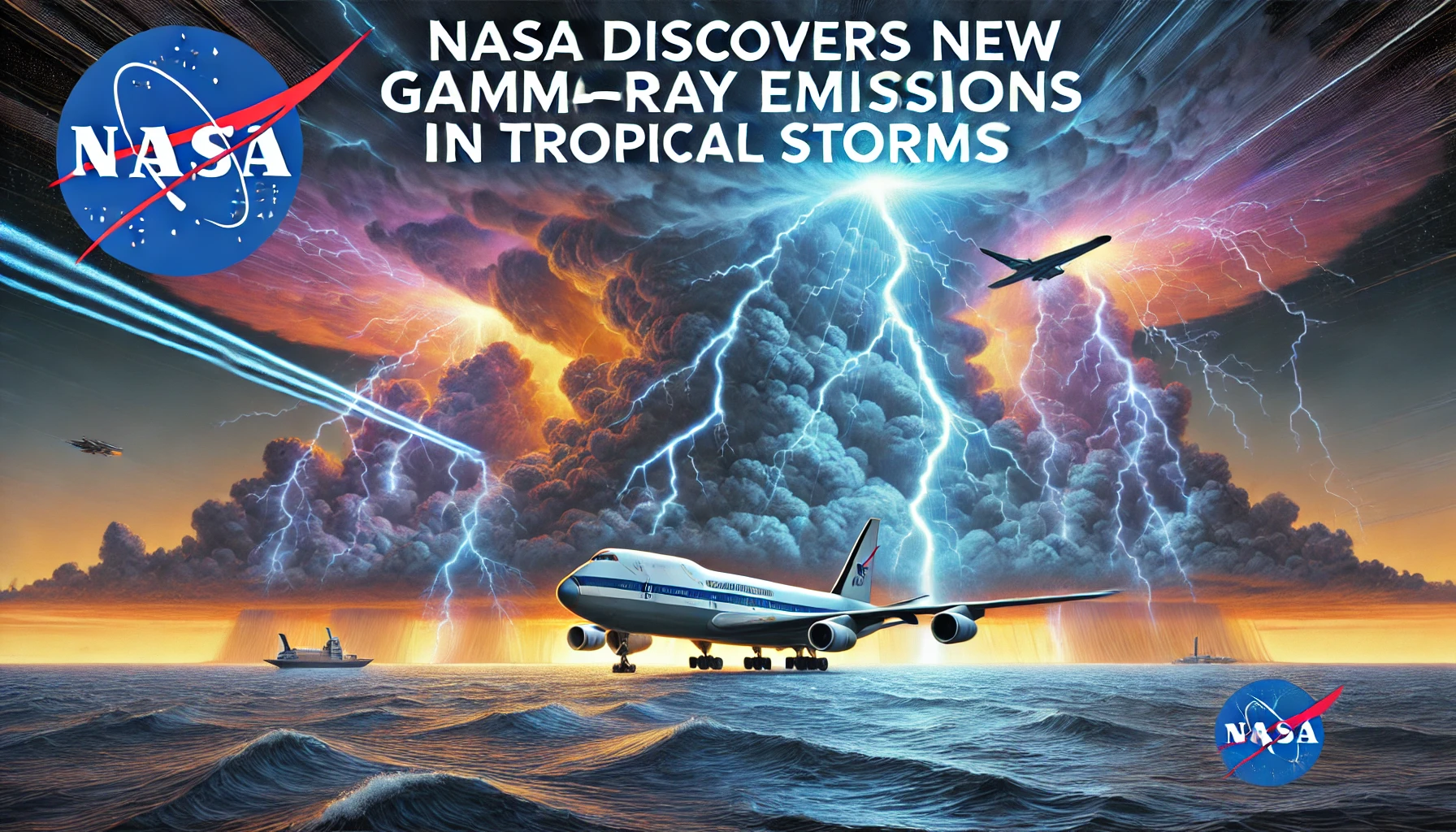
NASA’s tropical storm research has led to incredible breakthroughs in our understanding of gamma-ray emissions. In collaboration with international research teams, NASA has used airborne platforms to observe gamma-ray flashes and glows in tropical thunderstorms(NASA Science)(NASA Technical Reports Server). These observations have been conducted using advanced instruments such as the ALOFT (Airborne Lightning Observatory for Fly’s Eye Geostationary Lightning Mapper Simulator and Terrestrial Gamma-ray Flashes) campaign, which has provided detailed data on the interaction between thunderstorms and gamma rays.
NASA’s research found that gamma-ray emissions occur more frequently in tropical regions due to the higher levels of storm intensity and lightning activity. In fact, tropical storms, hurricanes, and typhoons have all been found to generate significant amounts of gamma-ray flashes, with emissions occurring in the outer rainbands of these storms, where lightning is most intense(NASA Scientific Visualization Studio).
The Role of Space Weather in Gamma-ray Emissions
While gamma-ray flashes are generated in Earth’s atmosphere, there is also a connection to space weather. Space weather, which includes solar flares and other cosmic events, can influence Earth’s magnetic field and affect atmospheric conditions. NASA researchers are studying how changes in space weather may impact the frequency and intensity of gamma-ray flashes in storms(NASA)(NASA Scientific Visualization Studio).
For instance, during periods of heightened solar activity, Earth’s magnetosphere can become disturbed, leading to stronger electric fields in the atmosphere. These conditions may increase the likelihood of TGFs and other gamma-ray emissions in thunderstorms, making space weather an important factor in understanding these high-energy phenomena.
Implications for Future Research and Storm Safety
NASA’s discovery of new types of gamma-ray emissions has far-reaching implications, not just for the field of atmospheric science but also for storm safety. Understanding how gamma rays are produced in thunderstorms can help improve models for lightning risk, potentially leading to more accurate safety warnings for aircraft, spacecraft, and people on the ground.
As research continues, NASA’s findings may also contribute to advancements in our understanding of space weather and its effects on Earth. The data collected from the NASA Fermi Gamma-ray Space Telescope and the ALOFT campaign will be crucial in refining our knowledge of storm behavior and gamma-ray emissions in the years to come(NASA Scientific Visualization Studio).
The Future of Gamma-ray Research in Thunderstorms
NASA’s recent discoveries surrounding gamma-ray emissions in tropical thunderstorms represent a significant leap forward in our understanding of Earth’s atmosphere. From terrestrial gamma-ray flashes to gamma-ray glows, these high-energy phenomena have opened new avenues for research and highlighted the powerful forces at play within our planet’s weather systems.
As NASA continues to explore these emissions using advanced technology like the Fermi Gamma-ray Space Telescope, we can expect even more exciting discoveries about how tropical thunderstorms produce gamma rays and the implications for space weather and storm safety.
For more insights into scientific phenomena and space research, visit Regent Studies for in-depth resources on atmospheric science and space exploration.
External Source: NASA Fermi Gamma-ray Space Telescope Overview