
The Largest Volcano on Mars May Sit Above a 1,000-Mile Magma Pool: Could Olympus Mons Erupt Again?
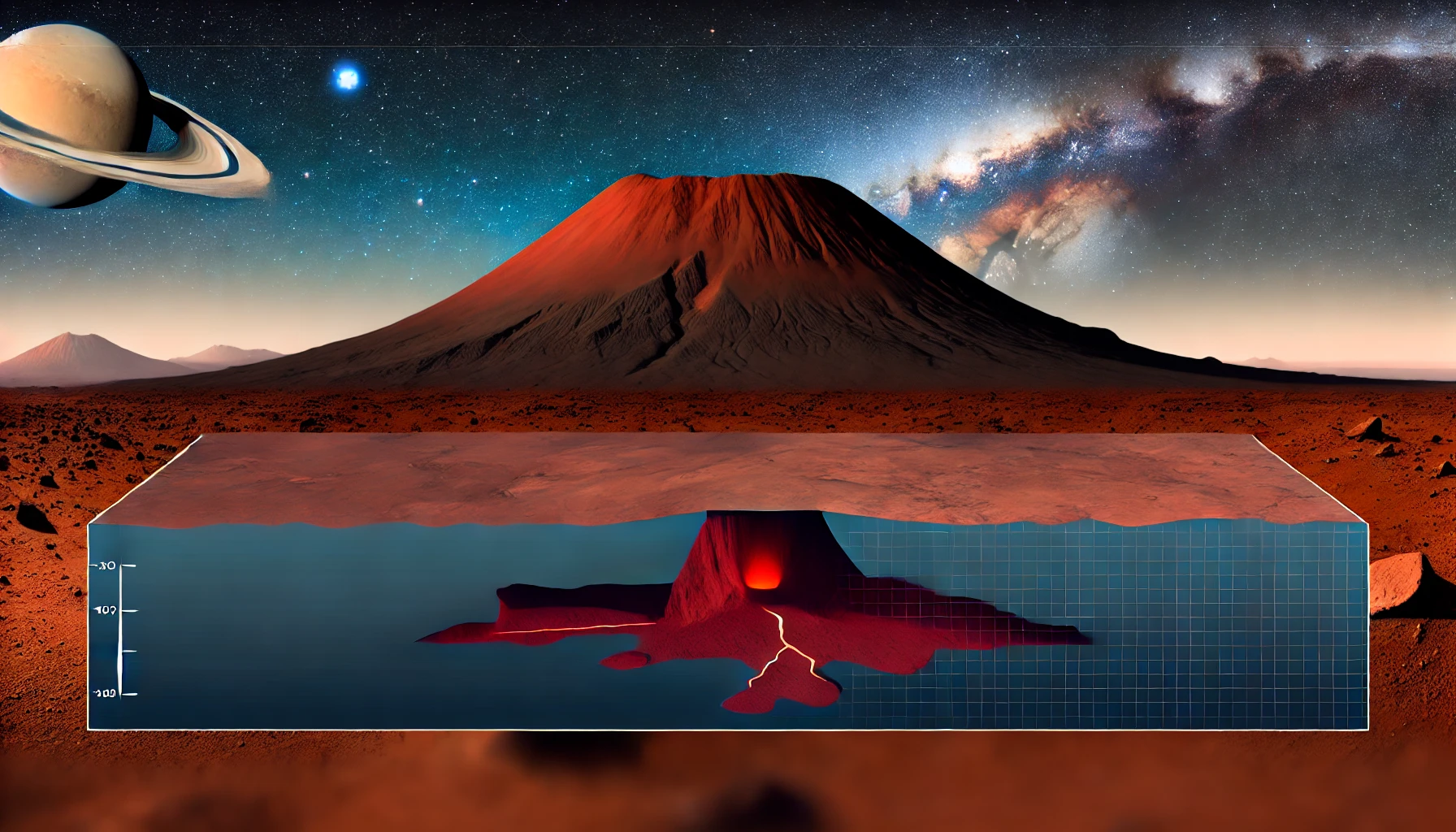
Mars has always captivated our imagination, from its red hue to the evidence of ancient water channels snaking across its surface. But one of the most fascinating features of the Red Planet is undoubtedly Olympus Mons—the largest volcano in the solar system. Towering at approximately 13.6 miles (22 kilometers) high and spanning about 370 miles (600 kilometers) in diameter, Olympus Mons dwarfs Earth’s tallest mountains and volcanoes. Recent studies suggest that this colossal shield volcano might still be sitting above a vast magma pool stretching 1,000 miles beneath its surface. But what does this mean for the future of the volcano? Could Olympus Mons erupt again?
In this blog, we’ll explore the geological makeup of Olympus Mons, discuss the possibility of future volcanic activity, and dive into the potential for Mars volcanoes to still be active.
Olympus Mons: The Largest Volcano in the Solar System
At first glance, Olympus Mons might seem like an ancient, dormant volcano, yet it holds some remarkable secrets. Standing nearly three times the height of Mount Everest and covering an area the size of Arizona, this shield volcano formed over billions of years as lava flowed repeatedly from its central vent. Its gentle slopes, ranging between 2 and 5 degrees, are characteristic of shield volcanoes, which are built by highly fluid basaltic lava flows that can travel great distances before solidifying(Space.com)(Wikipedia).
What’s truly fascinating is that some sections of Olympus Mons are relatively young in geological terms—only a few million years old, compared to the planet’s overall age of 4.5 billion years(My Modern Met). This has led scientists to believe that Olympus Mons may still have the potential to erupt, especially given the signs of volcanic activity in other regions of Mars.
Mars Volcanoes and Their Geological Significance
Mars is home to several massive volcanoes, with Olympus Mons being the most prominent. Other major Mars volcanoes are located in the Tharsis region, a vast volcanic plateau that is home to three other massive shield volcanoes—Ascraeus Mons, Pavonis Mons, and Arsia Mons. These volcanoes were formed due to Mars’ lack of tectonic plates. Unlike Earth, where plate movement disperses volcanic activity, the stationary crust of Mars allowed lava to build up in a single spot over time, leading to the massive size of these volcanic features(Wikipedia).
But why is the presence of these Mars volcanoes so important? First, they help us understand the geology of Mars. Studying these massive structures can reveal how volcanic activity shaped the Martian surface, offering clues to the planet’s evolution and its potential for supporting life. Some scientists also believe that volcanic activity could have created the conditions necessary for liquid water on the surface during Mars’ early history(Space.com).
What Is a Magma Pool, and Could Olympus Mons Erupt Again?
The discovery of a magma pool stretching 1,000 miles beneath Olympus Mons has sparked significant interest. This magma chamber could indicate that the volcano is not entirely dormant. Magma pools are vast underground reservoirs of molten rock, and if sufficient pressure builds up, they can cause volcanic eruptions.
On Earth, we see similar structures under active volcanoes like Yellowstone and Hawaii’s Mauna Loa, both of which have erupted in recent history. However, the question remains: could a similar event occur on Mars?
There are a few key differences between Earth and Mars that complicate the matter. First, Mars’ lack of tectonic activity means that the forces that usually trigger eruptions on Earth are absent. But this doesn’t completely rule out the possibility of an eruption. The buildup of pressure in a magma pool under Olympus Mons could still cause the volcano to erupt(My Modern Met).
Tectonic Activity on Mars: A Key Factor in Future Eruptions
Unlike Earth, where tectonic plates shift and interact, Mars’ crust is static, which has allowed massive volcanoes like Olympus Mons to form and grow over time. On Earth, the shifting of plates creates new volcanic islands and spreads volcanic activity across different areas. In contrast, the lack of tectonic movement on Mars allowed lava to continually flow from the same hotspot, gradually creating Olympus Mons over billions of years(USGS).
The absence of tectonic movement means that volcanoes like Olympus Mons grow much larger than those on Earth. It also means that volcanic activity is more isolated, making it harder to predict when—or if—eruptions will occur. The Tharsis region of Mars, where Olympus Mons is located, has been volcanically active for much of the planet’s history, but recent studies suggest that volcanic activity may have significantly slowed down(Wikipedia).
However, the existence of the 1,000-mile magma pool hints that some volcanic processes could still be happening deep beneath the surface. If the pressure in this chamber increases over time, an eruption could be triggered, though it’s impossible to predict when this might happen.
The Tharsis Region and Its Impact on Mars’ Geology
The Tharsis region is not just home to Olympus Mons but also several other large volcanoes, as well as a series of fractures and rift valleys that suggest significant tectonic and volcanic activity in Mars’ past. This region has played a crucial role in shaping the geology of Mars, and studying it gives scientists a window into the planet’s history(USGS).
Geological evidence from the Tharsis region indicates that this area was volcanically active for over two billion years. In fact, researchers have discovered ancient lava flows that may be as young as two million years, leading to the hypothesis that volcanic activity on Mars may not be entirely extinct(My Modern Met).
The presence of water ice in the Tharsis region also suggests that volcanic heat may have melted underground ice, possibly creating temporary liquid water environments—an exciting prospect for astrobiologists looking for signs of life.
Active Volcanoes on Mars: Are There Any Left?
The idea of active volcanoes on Mars is still hotly debated. While Olympus Mons and the other Mars volcanoes are currently inactive, it’s unclear whether this state is permanent. Some researchers believe that volcanic activity on Mars could still occur, particularly in regions like Tharsis and Elysium, which show signs of relatively recent lava flows(My Modern Met)(USGS).
While Mars does not experience the kind of frequent eruptions we see on Earth, the possibility of a future eruption cannot be completely ruled out. In fact, the existence of the magma pool beneath Olympus Mons raises the question of whether this massive volcano could one day erupt again.
The Future of Olympus Mons and Mars Volcanism
Olympus Mons stands as a towering testament to the power of Mars’ volcanic activity. As the largest volcano in the solar system, it continues to intrigue scientists and space enthusiasts alike. The discovery of a magma pool beneath the surface has reignited interest in whether Olympus Mons could erupt again, and what that would mean for our understanding of Mars’ geological activity. While the absence of tectonic plates makes an eruption less likely compared to Earth, the possibility still exists.
As we continue to explore Mars with rovers, orbiters, and future missions, the mysteries of Olympus Mons and other Mars volcanoes will undoubtedly come into sharper focus. To learn more about the exciting possibilities of planetary geology and space exploration, visit Regent Studies for in-depth resources and educational content.
For additional information on Mars volcanoes and Olympus Mons, check out NASA’s dedicated page on Martian geology here.