
China’s Ambitious Plans: Building a Moon Base at the Lunar South Pole by 2035
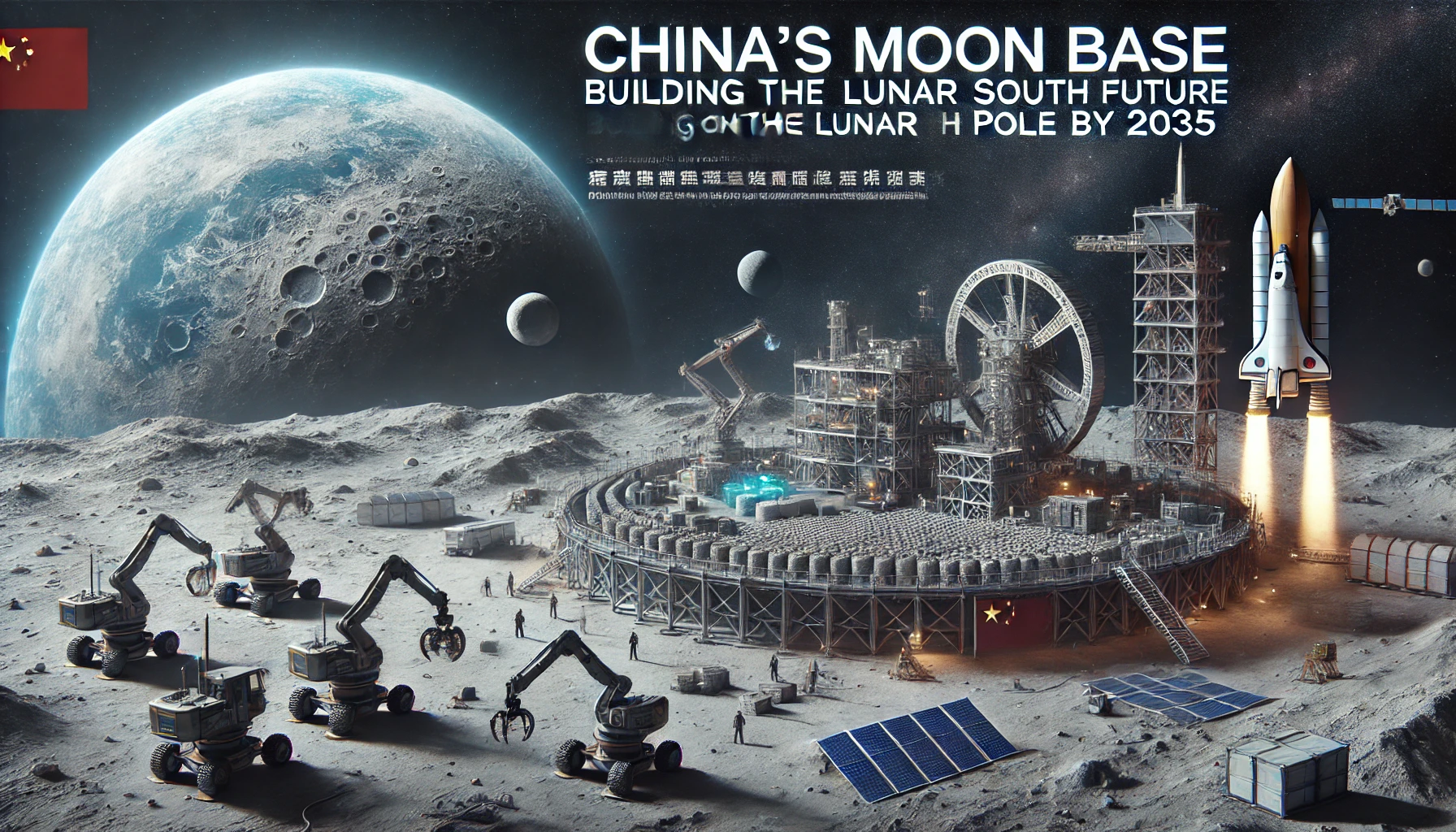
China’s space exploration program has made significant strides in recent years, culminating in the ambitious goal of constructing a moon base at the lunar south pole by 2035. This project, which will involve advanced technologies such as moon bricks made of lunar soil, 3D printing, and a Moon-Earth communication network, underscores China’s determination to establish a long-term presence on the Moon. With the Chang’e missions paving the way and international collaborations through the International Lunar Research Station (ILRS), this plan represents China’s bold vision for space exploration.
In this blog, we will explore the details of China’s moon base project, the importance of the lunar south pole, and the global competition in space exploration, particularly with NASA’s Artemis program. We’ll also delve into how China plans to construct the base using local lunar resources and develop a sustainable infrastructure for future space missions.
Why the Lunar South Pole?
The lunar south pole is an attractive location for space agencies worldwide, not just for China. Unlike the Moon’s equatorial regions, the poles offer a number of advantages for establishing a moon base. First, the south pole is home to areas that receive near-continuous sunlight, making it ideal for generating solar power. In addition, this region contains permanently shadowed craters where water ice has been detected. This water could be used for drinking, as a component in oxygen production, or even to make rocket fuel through electrolysis(Space.com)(Space.com).
China’s Strategy for the Lunar South Pole
China’s moon base project aims to capitalize on these advantages. The Chang’e missions, including Chang’e-6 and Chang’e-8, are central to this plan. These missions are designed to bring back samples and explore the feasibility of using lunar resources, particularly water and soil, to support the construction of the International Lunar Research Station (ILRS)(Space.com). The ILRS will serve as a foundation for future missions, and China plans to collaborate with other countries on this long-term project(Futurism).
By 2035, China hopes to have a fully operational base that will not only allow astronauts to stay on the Moon for extended periods but also act as a launchpad for missions deeper into space.
Building the Moon Base: Lunar Soil and Moon Bricks
One of the most innovative aspects of China’s plan is the use of moon bricks made of lunar soil for construction. This technique is part of China’s broader goal to minimize the amount of material that needs to be transported from Earth, which is expensive and logistically complex. Instead, Chinese scientists are working on developing technologies that will allow them to use the Moon’s own resources, including 3D printing technologies that can turn lunar soil into moon bricks(Futurism).
3D Printing and In-Situ Resource Utilization (ISRU)
Using 3D printing, also known as in-situ resource utilization (ISRU), China aims to build the infrastructure of the moon base directly on the lunar surface. This will involve printing structures layer by layer using lunar soil, reducing the need for transporting heavy construction materials. In 2023, Chinese scientists demonstrated a prototype of a habitat made from these bricks, marking an important step toward realizing this vision(Futurism).
The use of local resources is crucial not just for building the moon base but also for creating a sustainable presence on the Moon. Future missions will depend on the ability to live off the land—whether by extracting water, producing oxygen, or manufacturing tools and parts from lunar materials.
The Role of the Chang’e Missions
China’s Chang’e missions have been instrumental in laying the groundwork for the construction of a lunar base. The Chang’e-5 mission successfully brought back samples from the Moon in 2020, and upcoming missions like Chang’e-6 and Chang’e-8 will play key roles in exploring the south pole and testing technologies needed for the International Lunar Research Station (ILRS).
Chang’e-6: Exploring the Far Side of the Moon
Chang’e-6 is scheduled to launch in 2025 and will be China’s first mission to collect samples from the Moon’s far side, an area that remains largely unexplored. This mission is part of a broader collaboration between China and international partners, with French and other European scientists contributing to the study of lunar samples(Space.com).
Chang’e-8: Testing Moon Base Technologies
The Chang’e-8 mission, slated for the late 2020s, will test key technologies for the construction of the moon base. This includes the development of infrastructure, such as energy generation systems, and the exploration of lunar resources that can be used in the 3D printing process(Space.com)(Space.com). The mission will also assess how to build habitats that can protect astronauts from the harsh conditions on the Moon.
Global Competition: China vs. NASA’s Artemis Program
China’s ambitions for building a moon base at the lunar south pole by 2035 are a clear indication of the country’s growing influence in space exploration. However, China is not the only player in this new space race. NASA’s Artemis program, which aims to return humans to the Moon by 2025 and establish a sustainable presence by 2030, represents a significant competitor(Space.com)(Space.com).
NASA’s Artemis Program and the Lunar Gateway
The Artemis program is NASA’s flagship initiative to land humans on the Moon again and establish a Lunar Gateway, a space station orbiting the Moon. The gateway will serve as a staging point for missions to the Moon’s surface and, eventually, to Mars. NASA has also announced plans to build a base camp near the lunar south pole, where astronauts will be able to conduct long-duration missions(Space.com).
Space Race 2.0: Collaboration or Competition?
The race to the Moon is not just about technological achievements but also about geopolitical influence. While NASA and China have both expressed interest in collaborating on space exploration, there are significant hurdles to overcome, including political tensions and competition for resources. The future of lunar exploration may involve a combination of collaboration and competition as both countries aim to secure a foothold on the Moon(Futurism).
Future Technologies: Moon-Earth Communication Network
An essential part of China’s plan for a moon base is the development of a Moon-Earth communication network. This network will allow for continuous communication between the Moon and Earth, enabling real-time data transmission and coordination of activities on the lunar surface. A robust communication system will be crucial for managing long-term operations, scientific experiments, and future manned missions(Space.com).
Building a Sustainable Lunar Presence
For China’s moon base to succeed, it will need to rely on a combination of advanced technologies, including renewable energy sources like solar power, efficient recycling systems, and a reliable communication network. The development of a Moon-Earth communication network will be a key part of this infrastructure, supporting everything from navigation to remote operations(Space.com)(Futurism).
China’s Path to the Moon
China’s plan to build a moon base at the lunar south pole by 2035 is an ambitious and bold move that signals the country’s growing influence in space exploration. By leveraging innovative technologies like moon bricks made from lunar soil and 3D printing, China aims to establish a sustainable lunar presence. The Chang’e missions, particularly Chang’e-6 and Chang’e-8, will play a critical role in paving the way for this endeavor.
As global interest in the Moon heats up, the competition between China and NASA’s Artemis program could shape the future of space exploration. Whether through collaboration or rivalry, the race to the Moon promises to be one of the most exciting chapters in human history.
For more educational resources on space exploration and future lunar missions, visit Regent Studies. To learn more about China’s lunar plans, check out this informative article(Futurism).